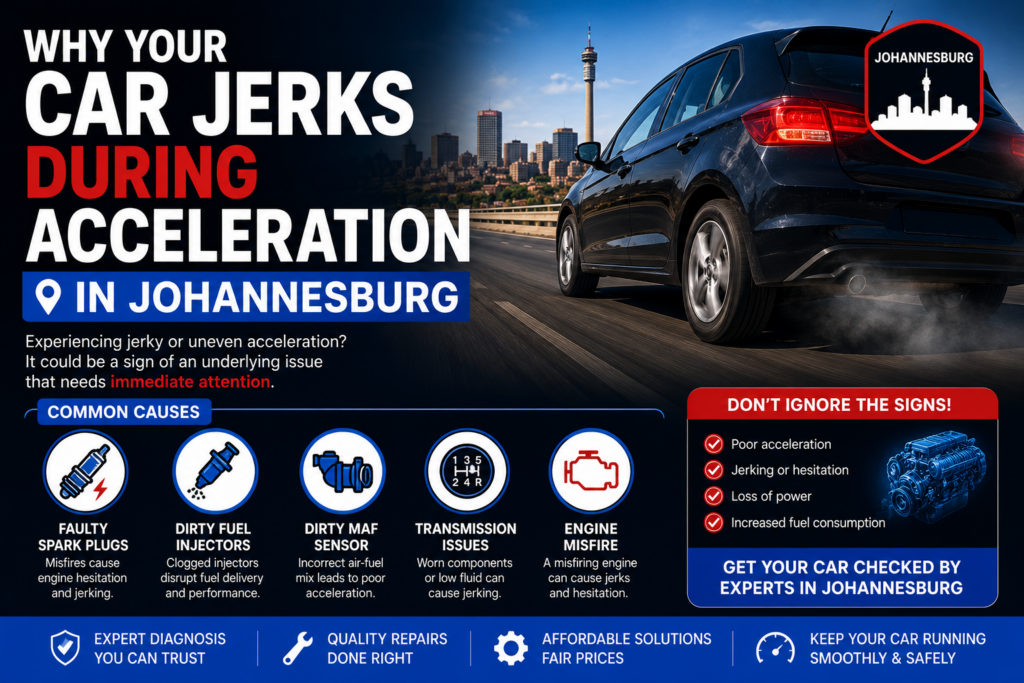
Why Your Car Jerks During Acceleration in Johannesburg
If your car jerks, hesitates, shudders, or feels unstable while accelerating, it’s usually a sign that something in the engine, fuel, ignition, or transmission system is no longer operating correctly.
Many Johannesburg drivers first notice jerking while driving in traffic, accelerating onto highways, climbing hills, or trying to pull away from robots. In some cases the problem starts mildly and gradually becomes worse over time.
Jerking during acceleration should never be ignored because it often indicates a developing mechanical or electronic fault that can eventually lead to stalling, poor fuel economy, warning lights, or complete breakdowns.
We provide mobile diagnostics across Johannesburg to identify acceleration problems properly and help prevent larger repairs later.
What Causes Jerking During Acceleration?
Jerking during acceleration happens when the engine is unable to deliver smooth and consistent power to the wheels. This interruption can come from fuel delivery problems, ignition faults, airflow issues, sensor failures, transmission problems, or electronic system faults.
Modern vehicles rely heavily on engine management systems and sensors to control fuel mixture, ignition timing, throttle response, and airflow. If one component begins failing, the engine may struggle to maintain stable acceleration.
In many situations, the problem begins intermittently before becoming more severe. Drivers may only notice jerking occasionally at first, especially while accelerating uphill or during stop-start traffic conditions.
Over time, the issue often becomes more frequent and may eventually trigger engine warning lights, stalling, rough idling, or poor fuel consumption.
Proper diagnostics are important because several different systems can create similar symptoms.
Fuel Delivery Problems
Fuel delivery problems are one of the most common causes of jerking while accelerating. The engine requires consistent fuel pressure to produce smooth power, and even small interruptions can create hesitation or jerking sensations.
A failing fuel pump, blocked fuel filter, dirty injectors, or faulty fuel pressure regulator can all affect fuel delivery performance.
Drivers often notice additional symptoms such as sluggish acceleration, poor throttle response, difficulty starting, or increased fuel consumption before the problem becomes severe.
Johannesburg traffic conditions can make fuel delivery problems more noticeable because vehicles constantly alternate between braking and acceleration in stop-start traffic.
If fuel usage has also increased, see our fuel consumption problem guide.
Ignition System Problems
Ignition faults are another major cause of jerking during acceleration. Spark plugs, ignition coils, and related electrical components are responsible for igniting the air-fuel mixture inside the engine cylinders.
If ignition timing becomes inconsistent or one cylinder misfires, the engine may feel unstable or hesitate during acceleration.
Drivers commonly notice rough idling, misfiring, engine vibration, reduced power, or flashing engine warning lights when ignition faults develop.
Ignition problems usually worsen gradually and can eventually lead to stalling or complete starting failure if ignored for too long.
Engine warning lights often appear alongside ignition faults. See our engine warning light Johannesburg guide.
Throttle Body and Airflow Issues
Modern engines depend heavily on proper airflow management. Dirty throttle bodies, airflow sensor problems, vacuum leaks, and intake system faults can all affect acceleration performance.
The throttle body controls how much air enters the engine. If carbon buildup or contamination affects throttle operation, the vehicle may hesitate or jerk while accelerating.
Airflow problems are especially noticeable during stop-start driving conditions because the engine constantly adjusts between idle and acceleration.
Many drivers also notice unstable idling, hesitation while pulling away, or delayed throttle response when airflow systems become dirty or faulty.
Proper cleaning and diagnostics help identify whether the issue involves airflow sensors, throttle components, or vacuum system leaks.
Transmission Problems Can Also Cause Jerking
In some vehicles, jerking during acceleration is related to transmission problems rather than the engine itself. Automatic transmissions rely on smooth gear changes and proper fluid pressure to transfer power correctly.
Worn transmission fluid, delayed shifting, clutch problems, gearbox faults, or transmission sensor issues can create jerking or sudden surging sensations while driving.
Drivers may notice hard shifting, delayed acceleration, slipping gears, or unusual noises alongside the jerking symptoms.
Transmission problems should always be diagnosed early because continuing to drive with gearbox faults can lead to significantly more expensive repairs later.
Proper diagnostics help determine whether the problem originates from the engine, transmission, or electronic systems.
Why Johannesburg Traffic Makes Jerking More Noticeable
Johannesburg traffic conditions make acceleration problems more obvious because vehicles constantly alternate between braking, idling, and accelerating.
Stop-start traffic places additional strain on fuel systems, ignition systems, throttle components, and transmission systems. Problems that may seem minor on open roads often become much more noticeable in heavy commuting conditions.
Drivers who commute long distances daily are also more likely to notice worsening symptoms because the vehicle operates under heavier load for extended periods.
Vehicles used mainly in city traffic often develop carbon buildup, airflow contamination, and cooling system strain faster than vehicles driven mostly on highways.
Early diagnostics help identify developing faults before they eventually cause stalling or complete breakdowns.
Why You Shouldn’t Ignore Jerking During Acceleration
Many drivers continue driving with jerking or hesitation problems because the vehicle still feels usable initially. Unfortunately, these symptoms usually indicate an underlying fault that gradually becomes worse over time.
Ignoring acceleration problems can eventually lead to:
- Stalling while driving
- Complete starting failure
- Poor fuel economy
- Overheating
- Engine warning lights
- Damage to ignition or fuel components
- Transmission damage
Small faults are usually far cheaper to repair than major breakdowns later.
Diagnosing the issue early helps prevent larger repair costs and reduces the risk of roadside breakdowns.
Mobile Diagnostics for Jerking and Hesitation Problems
Proper diagnostics are essential because several different mechanical and electronic systems can create similar acceleration symptoms.
We provide mobile diagnostics across Johannesburg to identify fuel system faults, ignition problems, airflow issues, charging system faults, warning lights, and acceleration-related problems directly at your location.
Frequently Asked Questions
Why does my car jerk while accelerating?
Common causes include fuel delivery problems, ignition faults, airflow issues, sensor failures, or transmission problems.
Can bad spark plugs cause jerking?
Yes. Worn spark plugs or ignition coils can cause misfires and unstable acceleration.
Can low fuel pressure cause hesitation?
Yes. Weak fuel pumps, blocked filters, or injector problems can interrupt fuel delivery and create hesitation or jerking.
Can a mobile mechanic diagnose acceleration problems?
Yes. Mobile diagnostics can identify fuel, ignition, airflow, sensor, and electronic faults directly at your location.