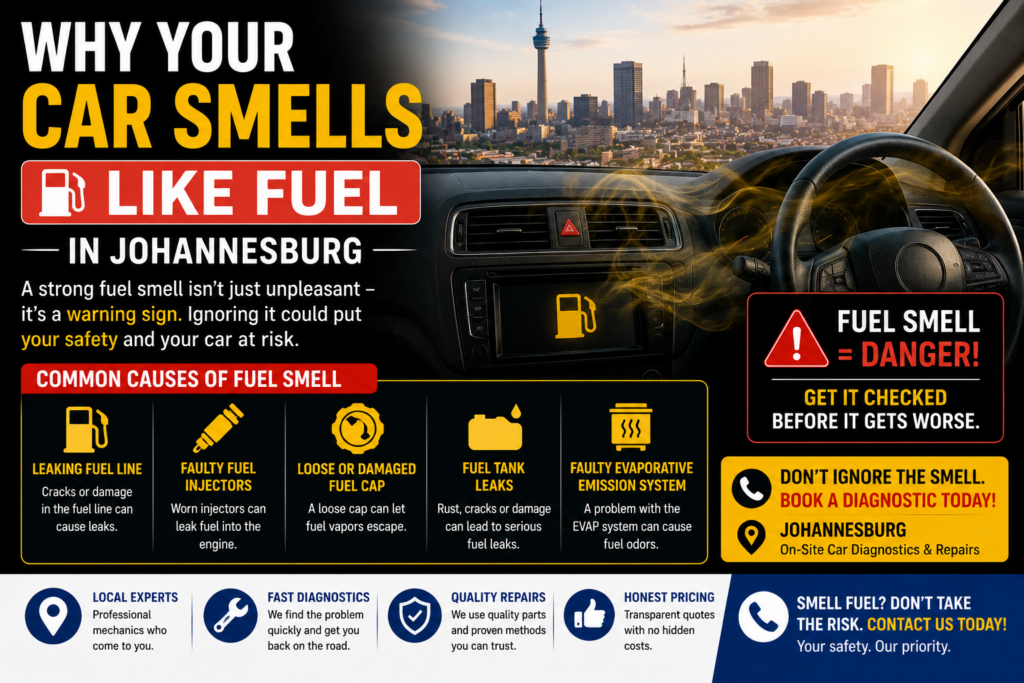
Why Your Car Smells Like Fuel in Johannesburg
A fuel smell inside or around your vehicle should never be ignored. While some fuel odour may occasionally be noticeable immediately after refuelling, a persistent petrol smell often indicates a fault somewhere in the fuel, emissions, ignition, or engine management system.
Many Johannesburg drivers first notice the smell while driving in traffic, starting the vehicle in the morning, parking in a garage, or sitting at traffic lights with the windows open. In some cases the smell remains outside the vehicle, while in others it can enter the cabin and become quite strong.
Because fuel is highly flammable, any unexplained fuel smell should be investigated as soon as possible. Small leaks can become larger leaks, damaged fuel system components can fail completely, and emissions faults can affect vehicle performance and fuel economy.
Understanding the possible causes can help you identify warning signs early and prevent more serious problems later.
Why a Fuel Smell Should Never Be Ignored
Fuel systems are designed to be completely sealed. Under normal circumstances, petrol should travel from the fuel tank to the engine without allowing vapours or liquid fuel to escape. If a noticeable smell develops, it usually means something is no longer functioning correctly.
Many drivers continue using the vehicle because it still drives normally. However, fuel-related faults often worsen gradually. What begins as a minor vapour leak may eventually become a fuel leak, trigger warning lights, reduce fuel economy, or even create a fire risk.
Fuel smells can also indicate that the engine is burning fuel inefficiently. In these situations, the vehicle may consume more petrol than normal and eventually develop performance problems.
Early diagnosis is usually far cheaper and safer than waiting until additional symptoms appear.
Fuel Leaks Are the Most Serious Cause
One of the most serious causes of a fuel smell is an actual fuel leak. Fuel lines, connectors, injector seals, fuel rails, and hoses can deteriorate over time due to age, vibration, heat, and general wear.
Even a small leak can produce a strong smell because petrol evaporates quickly. In some cases drivers may notice fuel stains under the vehicle, while in other cases the leak is so small that only the smell is noticeable.
Fuel leaks should always be treated as urgent because fuel vapours are highly flammable. A leak near hot engine components can become a significant safety risk if ignored.
Drivers may also notice increased fuel consumption, difficult starting, rough running, or warning lights if fuel delivery is affected.
If a strong fuel smell suddenly develops, the vehicle should be inspected immediately.
Faulty Fuel Injectors or Injector Seals
Fuel injectors deliver precise amounts of fuel into the engine. If injector seals become damaged or injectors begin leaking, fuel vapours can escape around the engine bay.
Because injectors operate under pressure, even small leaks can create noticeable fuel odours. Drivers often notice the smell shortly after starting the vehicle or while the engine is idling.
Faulty injectors can also affect fuel economy, idle quality, starting performance, and engine smoothness. In some cases, fuel may not be atomised correctly, causing incomplete combustion.
As the problem develops, the engine may begin running rough, consuming more fuel, or displaying warning lights on the dashboard.
Injector problems should be diagnosed properly because several different fuel system faults can produce similar symptoms.
EVAP System Problems
Modern vehicles use an Evaporative Emissions Control System (EVAP) to capture fuel vapours and prevent them from escaping into the atmosphere. This system includes hoses, valves, sensors, charcoal canisters, and sealed fuel system components.
If a component within the EVAP system fails, fuel vapours may escape and create noticeable petrol smells without any actual liquid fuel leak being present.
A loose or damaged fuel cap is one of the simplest EVAP-related causes. However, purge valve failures, cracked hoses, damaged seals, or charcoal canister issues can also create similar symptoms.
EVAP faults frequently trigger engine warning lights because modern engine management systems monitor fuel vapour containment closely.
If a fuel smell appears alongside a warning light, proper diagnostics are recommended.
Running Rich Can Cause Fuel Odours
Vehicles that run rich burn more fuel than necessary. When too much fuel enters the combustion process, unburned fuel may pass through the engine and create noticeable fuel smells.
Common causes include faulty oxygen sensors, airflow sensor problems, injector issues, fuel pressure faults, and engine management errors.
Drivers often notice additional symptoms such as increased fuel consumption, black exhaust smoke, rough idling, sluggish acceleration, or reduced engine performance.
A rich-running engine not only wastes fuel but can also damage catalytic converters and increase emissions over time.
Compare symptoms with our Car Using Too Much Fuel in Johannesburg guide.
Engine Warning Lights and Fuel Smells
Many fuel-related faults eventually trigger engine warning lights. Modern engine management systems constantly monitor fuel delivery, emissions performance, oxygen sensor readings, fuel trims, and vapour containment systems.
When abnormal readings are detected, fault codes are stored and warning lights may appear on the dashboard.
Ignoring warning lights while a fuel smell is present can allow minor faults to become larger repair problems. Diagnostic testing helps identify the specific system involved instead of relying on guesswork.
Because multiple faults can produce similar symptoms, scanning fault codes is often the fastest way to identify the root cause.
Learn more from our Engine Warning Light Johannesburg article.
Why Johannesburg Traffic Can Make Fuel Smells More Noticeable
Johannesburg traffic conditions often make fuel smells easier to notice because vehicles spend long periods idling, moving slowly, and operating under stop-start conditions.
When airflow around the vehicle is reduced, fuel vapours may linger longer around the engine bay and cabin area. Drivers are more likely to detect odours while sitting in traffic than while travelling at highway speeds.
Vehicles used mainly for city commuting may also develop carbon buildup, sensor contamination, and emissions system issues faster than vehicles used primarily for long-distance travel.
Drivers in areas such as Midrand, Randburg and Sandton often notice fuel-related symptoms earlier because of daily traffic exposure.
Mobile Diagnostics for Fuel System Problems
Because fuel smells can originate from leaks, injector faults, EVAP system failures, sensor issues, fuel pressure problems, or engine management faults, professional diagnostics are often necessary.
Mobile diagnostics help identify fault codes, monitor fuel system performance, evaluate sensor data, and inspect components directly at your location.
Accurate testing helps avoid unnecessary parts replacement and ensures the actual cause is identified.
Learn more about our Car Diagnostics Johannesburg service.
Fuel Smell? Get It Checked Before It Gets Worse
A fuel smell may indicate anything from a loose fuel cap to a fuel leak, injector problem, or emissions system fault. Early diagnosis helps prevent safety risks and expensive repairs.
We provide mobile diagnostics throughout Johannesburg to identify fuel system and engine management problems quickly and accurately.